
How IOP and Mental Health Services in Guilford County, NC, Do the Deep Healing Work?
When we put a Band-Aid on a wound that needs stitches, it doesn’t do much good. The same can be said about taking occasional therapy when your mental health is in shambles, and you need more help than seeing a therapist once in a while.
While therapy alone can do wonders, it’s more like a surface-level solution for deeper problems. When a mental health struggle has been eating at you from the inside, simply getting through the day is not enough. Also, you can’t uproot a deep-seated problem by only trimming the leaves.
Therefore, IOP and mental health services in Guilford County, NC, help you outrun that weight and do the hard clinical work while keeping you grounded in your daily life.
If you want to fix things right from where they started going wrong, keep reading to see how
IOP and mental health services in Guilford County, NC, do that.
Forced Neuroplasticity (Rewiring through Repetition)
In simple words, neuroplasticity is your brain’s ability to change and build new pathways. It is how we learn to think or act by forming new connections between brain cells. When your mental health isn’t good, you need to build these pathways to change how you feel and act. Therefore, experts emphasize this during your therapy sessions.
However, standard therapy happens once a week and leaves too much time for old, toxic habits to take back control between sessions. Therefore, IOP and mental health services in Guilford County, NC, provide you with 9 to 15 hours of therapy every week. This creates a high-density environment where you can practice new ways of thinking, and the sheer volume of work works like a training camp for your mind.
Eventually, that forced neuroplasticity speeds up progress, and instead of waiting weeks for a small change, the program’s high frequency pushes your brain to reorganize itself faster.
Cooling Down Your Body’s False Alarms
To understand how deep healing works, imagine your nervous system as a network of nerves and cells that carry messages to and from your brain. This system’s job is to detect threats, and when you have been struggling with mental health issues or trauma, it can get stuck in survival mode.
Slowly, your brain begins to treat everyday stress like a life-threatening emergency, like a smoke detector going off every time you try to cook. And while this situation is a false alarm, your body reacts as if there is a real fire.
Needless to say, you cannot heal when your body is flooded with stress hormones. Therefore, IOP and mental health services in Guilford County, NC, break this cycle. In this model, you’re in a therapeutic environment pretty regularly, so your body finally gets a chance to cool down.
Peer Co-Regulation
Mirror neurons are brain cells that allow your brain to copy others’ actions or emotions. For example, if you see someone yawn, you’ll likely yawn too. Similarly, if you sit with someone calm, your brain begins to mirror that calmness. It’s simply a biological tool built into our heads to help us learn and connect.
So when you are alone, your brain may get stuck in a loop of stress because you don’t have any outside signals to help you reset. Luckily, IOP and mental health services in Guilford County, NC, put you in a group with others also working to get better. That group environment fosters co-regulation, and your nervous system starts to sync with the group’s peace and stability.
Executive Function Restoration
The Prefrontal Cortex is the part of your brain behind your forehead. Take it as a “manager” for your life, handling what we call Executive Function. Your ability to plan, focus, remember details, and manage your time all fall under the executive function.
Now, if you struggle with severe depression or anxiety, this area of the brain can become less active. As a result, you may feel a heavy brain fog, and even making simple decisions will be a whole task.
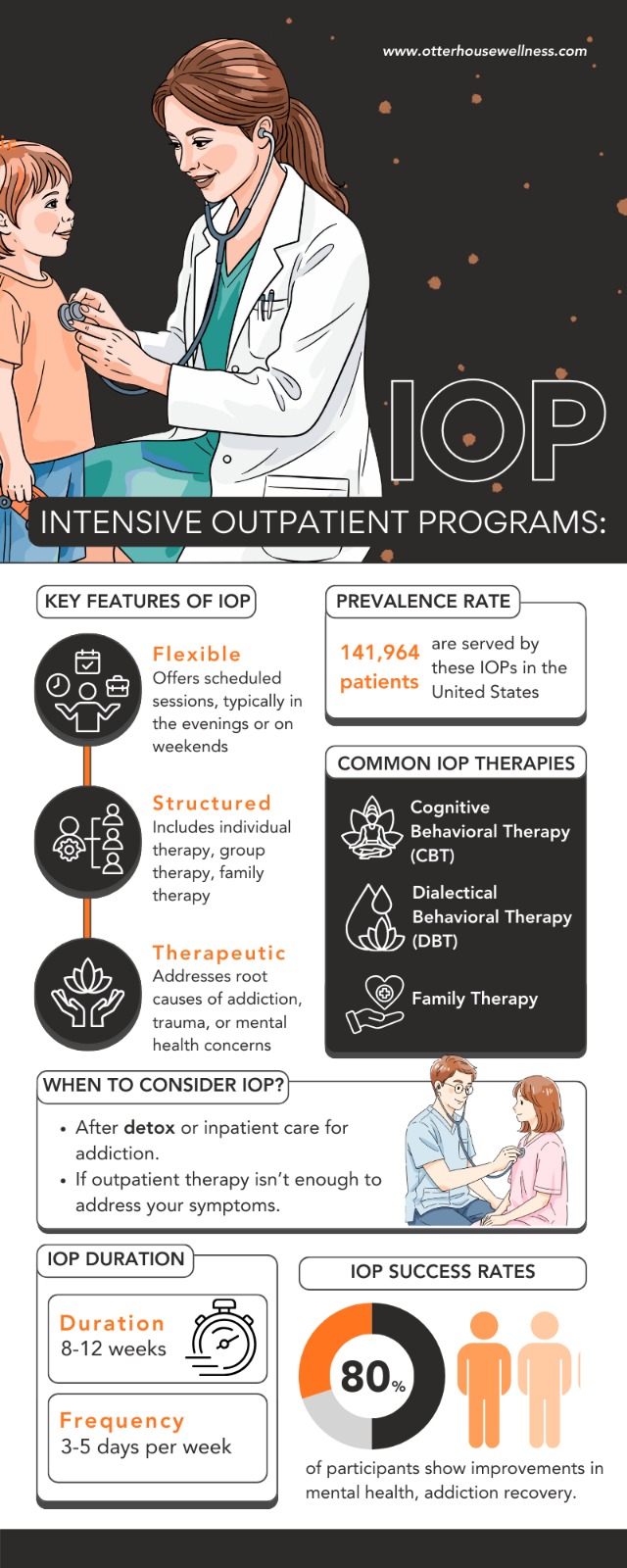
Therefore, IOP and mental health services in Guilford County, NC, focus on fixing this manager. For instance, when you’re mentally too tired to plan, an intensive outpatient program provides a structured schedule and clear guidelines. Then you don’t have to figure out what to do next because the program has already mapped it out.
The routine will slowly strengthen your prefrontal cortex, and your brain will feel healthy enough to handle tasks on its own again.
Breaking the Avoidance Loop
The Amygdala is a small part of your brain that helps you spot danger and stay safe. When you deal with trauma or anxiety, this guard becomes too sensitive and can see everything as a threat. Eventually, your brain cells tell you to avoid anything that feels uncomfortable, and that creates a loop: the more you avoid a fear, the bigger and scarier that fear grows.
That’s why IOP and mental health services in Guilford County, NC, work like a safe practice zone. In this controlled space, you can face your triggers with professionals by your side and learn how to stand your ground against them.
And since you return home after an IOP session, you can test your new strength right away to see what works. If you win a small battle against anxiety in therapy, you can check if it works at home that same evening. Facing the discomfort instead of hiding from it will starve your anxiety of its fuel and finally break the cycle of fear.
Do Deep Healing and Revive Yourself
When you leave a wound unattended, it only gets worse—the same applies to your mental health. That’s why experts suggest you take your mental condition very seriously and choose the right level of care instead of a cookie-cutter model. If you feel that only therapy isn’t bringing much change, IOP and mental health services in Guilford County, NC, will suit you just right. Call Otter House Wellness today, and we’ll make sure you’re on the right path to healing!
Otter House Wellness
January 27, 2026
- Telehealth Therapy That Accepts Medicaid in North Carolina
 Tired of spending gas money and half a day driving to a therapist? Discover how NC Medicaid lets you see top providers from home with zero copay.
 - Group Therapy Covered by Medicaid in North Carolina
 Replaying the exact same thoughts at 2 AM with no way out? Discover how NC Medicaid fully covers the group therapy hack that breaks your mental loops.
 - Outpatient Mental Health Treatment for Medicaid Recipients in NC
 Did you know you don't need a doctor's referral to start therapy on NC Medicaid? Discover how to access fast, free mental health care from home.
 - Medicaid Mental Health Treatment for Parents and Families in NC
 You can't pour from an empty cup. Discover the "oxygen mask" rule in NC Medicaid that covers parent AND child mental health under one plan.
 - Mental Health Programs for Young Adults on Medicaid in North CarolinaDoes Rhode Island Medicaid cover treatment for addiction and depression? Find out what’s covered, from detox and residential care to PHP, IOP, therapy, and medication.
- ADHD Treatment That Accepts Medicaid in North Carolina
 Looking for ADHD treatment that accepts Medicaid in North Carolina? Learn about treatment options and how support can make daily life easier.
 - Bipolar Disorder Treatment Covered by Medicaid in NC
 Learn about bipolar disorder treatment covered by Medicaid in NC, including therapy, medication, Medicaid plans, and support options at Otter House Wellness.
Recommended Blogs


Telehealth Therapy That Accepts Medicaid in North Carolina

Group Therapy Covered by Medicaid in North Carolina