
Mental Health Treatment in North Carolina: Which Therapy Approach Is Right for You?
Something changes the moment a person stops asking, “what is wrong with me?” and starts asking, “what kind of help genuinely works?”
The first question is a loop. It circles back on itself, fed by shame and exhaustion and the particular cruelty of symptoms that are invisible to everyone but the person carrying them. The second question is a door. It is worth pursuing because the answer is specific, grounded, and more hopeful than most expect.
Mental health therapy programs in North Carolina are a collection of approaches, each designed to reach a different part of what’s happening. The thoughts, the body, the behavior, the brain itself, the family system around a person, and the life they are trying to build through all of it.
Understanding what those approaches involve and why they work is not a clinical exercise. It is the difference between arriving at treatment as a passive recipient and arriving as someone who knows what they are walking into.
The Difference Between a Program and a Single Appointment
Most people have some experience with therapy. The weekly fifty-minute hour, in the same office and chair, allows for the slow accumulation of insight over months. That has real value, but it is not a therapy program.
A mental health therapy program is a structured treatment delivered at a higher frequency and depth. In North Carolina, that typically means PHP, IOP, or outpatient care built around multiple evidence-based modalities rather than a single therapeutic relationship. The structure itself is part of the treatment. Days that once felt formless start to have shape. Skills are practiced not just in theory but in the actual hours of the week that used to be the hardest to get through.
What fills those hours is worth understanding in detail because each mode has a specific purpose, and knowing what that purpose is changes how a person experiences the work.
Cognitive Behavioral Therapy: Learning to Argue With Your Own Mind
CBT is the most researched and widely used therapy in mental health treatment. It works from a deceptively simple premise: thoughts, emotions, and behaviors are connected. Change one, and the others shift too.
Practically, CBT assists individuals in discovering their thought patterns that are causing distress. The cognitive distortions, the catastrophizing, and the rigid beliefs about themselves and the world that feel like facts but are in fact interpretations. Then it educates humans to question such patterns. Not to substitute dark thoughts with fake optimism, but to look at them in a truthful manner and seek more realistic and habitable alternatives.
CBT has been shown to be effective in a wide range of mental health issues, most notably anxiety disorders, depression, PTSD, and OCD, and treatment typically requires 12–20 sessions, making it an effective option in the eyes of many. Within a structured therapy program, it is even stronger since the skills are reinforced on a daily basis, both in groups and at individual sessions. The ways of thinking that an individual develops over the years do not dissolve in a single discussion. They erode through repeated practice, in real time, with a clinician who knows where the resistance lives.
Dialectical Behavior Therapy: When the Emotion Is the Emergency
DBT was developed for people whose emotional experiences are so intense that ordinary coping strategies feel inadequate. People for whom distress doesn’t arrive gradually but crashes all at once. It has since proven effective across a much wider range of conditions, and it sits at the core of many North Carolina therapy programs for good reason.
When CBT asks, “What are you thinking?” DBT asks, “What are you feeling, and what do you do about it?” It builds four specific skill sets: mindfulness, emotion regulation, distress tolerance, and interpersonal effectiveness. Telephone consultations are also offered to help apply those skills in everyday life.
Group Therapy: The Room That Changes the Story
One of the most common fears people bring to a therapy program is the group. The idea of sitting with strangers and being expected to speak, to be witnessed, and to hear other people’s pain alongside their own sounds like the opposite of what someone in crisis needs.
It turns out to be one of the most powerful elements of treatment. Not because of any single conversation, but because of what the room does to the story a person has been telling themselves in isolation.
Most people who arrive at a mental health therapy program in North Carolina have been alone with their experience for a long time. The shame of struggling is partly built on the belief that the struggle is uniquely theirs.
The group dismantles that belief simply by existing. Other people are in the room. Other people know. Other people are still here, still working.
Group therapy also teaches how to be in a relationship while struggling. That is, ultimately, what recovery requires.
Family Therapy: Because Nothing Happens in Isolation
Mental health conditions do not live in just one person. They live in the systems around that person. The family patterns, the communication habits, the unspoken dynamics that have calcified over the years into something that feels unchangeable.
Family therapy does not assign blame. It maps the system and works to change it from within. It improves the conditions of recovery. It changes the conversations that happen at home in the hours between sessions.
For many people, the most durable healing happens not in the therapy room but in the shifted relationships around them. Family therapy is how that shift gets deliberately, carefully built.
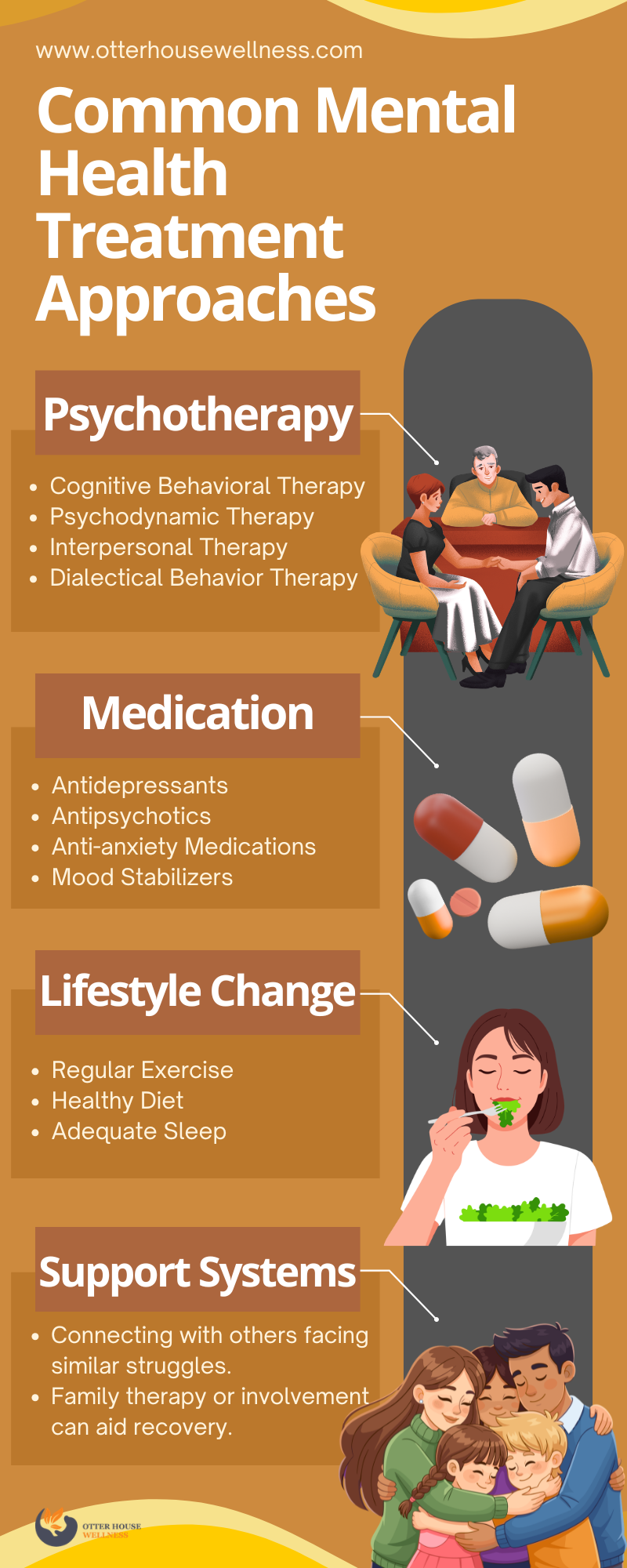
Final Words
At Otter House Wellness, a program is not poured over a person. Rather, each client is examined honestly and matched to the care that fits. PHP, IOP, individual therapy, group work, family sessions, and holistic practice are not checkboxes. They are tools selected with intention for the specific terrain of the person sitting across from the clinician on day one.
That is what a mental health therapy program in North Carolina should be. Not a process to endure. A path that was built for you. Reach out to the Otter House Wellness team today to learn what that path looks like for where you are right now.
Otter House Wellness
April 15, 2026
- Telehealth Therapy That Accepts Medicaid in North Carolina
 Tired of spending gas money and half a day driving to a therapist? Discover how NC Medicaid lets you see top providers from home with zero copay.
 - Group Therapy Covered by Medicaid in North Carolina
 Replaying the exact same thoughts at 2 AM with no way out? Discover how NC Medicaid fully covers the group therapy hack that breaks your mental loops.
 - Outpatient Mental Health Treatment for Medicaid Recipients in NC
 Did you know you don't need a doctor's referral to start therapy on NC Medicaid? Discover how to access fast, free mental health care from home.
 - Medicaid Mental Health Treatment for Parents and Families in NC
 You can't pour from an empty cup. Discover the "oxygen mask" rule in NC Medicaid that covers parent AND child mental health under one plan.
 - Mental Health Programs for Young Adults on Medicaid in North CarolinaDoes Rhode Island Medicaid cover treatment for addiction and depression? Find out what’s covered, from detox and residential care to PHP, IOP, therapy, and medication.
- ADHD Treatment That Accepts Medicaid in North Carolina
 Looking for ADHD treatment that accepts Medicaid in North Carolina? Learn about treatment options and how support can make daily life easier.
 - Bipolar Disorder Treatment Covered by Medicaid in NC
 Learn about bipolar disorder treatment covered by Medicaid in NC, including therapy, medication, Medicaid plans, and support options at Otter House Wellness.
Recommended Blogs


Telehealth Therapy That Accepts Medicaid in North Carolina

Group Therapy Covered by Medicaid in North Carolina