
Why Mental Health Rehab in North Carolina Isn’t What You Expect
North Carolina holds two kinds of quiet.
There is the quiet of the Blue Ridge at dusk, when the mountains go soft, and the light disappears slowly, like something being carefully put away. The second type lives inside people. It has nothing to do with peace and everything to do with exhaustion. Slowly settling in after years of managing and appearing fine in rooms full of people who have no idea how much that performance costs.
Most people who eventually seek mental health rehab in North Carolina have lived in that latter quiet for a long time. They are not in visible crisis. They are not at the bottom of anything dramatic. They are simply worn out. In a way that sleep does not touch; tired in a way that the next coping strategy probably won’t fix, either.
They have already tried the weekly therapy appointment. The new routine. The podcast was supposed to help. They are not looking for more information about what is wrong. They are looking for something that precisely matches the size of what they are carrying.
That is what this guide is for.
“Rehab” Doesn’t Mean What You Think It Means
The word carries weight it doesn’t always deserve. Most people in North Carolina hear “mental health rehab” and picture something extreme! A 30-day residential stay, a dramatic intervention, a life that has visibly collapsed. What they don’t picture is themselves.
However, mental health rehab is not a single thing. It is clinically called a continuum of care that runs from weekly outpatient sessions all the way to round-the-clock residential treatment, with several meaningful levels in between. And crucially, care is not static. People move up or down that continuum as their needs change, stepping from higher-intensity programs down toward standard outpatient therapy as stability builds. The goal was never to place someone in a category. It was always to match the level of support to the actual terrain of the moment.
That is a different question entirely and a much more answerable one than whether someone is “bad enough” to deserve help.
The Four Levels And What Each One Actually Involves
Understanding the continuum matters because most people who need mental health rehab in North Carolina need one of the middle levels. Not the most intensive. Not the least. The one that fits where they actually are.
Residential treatment is the level most people picture first. It offers a structured environment where someone stays at a facility, removed from the pressures and triggers of ordinary life, while receiving intensive therapeutic support 24/7.
It is right for the person whose home environment, however loving, is not a safe container for recovery right now.
Partial Hospitalization Programs (PHP) provide health care that is of the same intensity as inpatient care, but people go home every evening. The average day includes as many as six hours of formal therapeutic work.
You will receive five or more days of group therapy, one-on-one sessions, medication management, and skill-building.
This level exists for the person whose life has not visibly collapsed but whose internal scaffolding has quietly given way. The days stop feeling like something to endure and start feeling like something to use.
Intensive Outpatient Programs (IOP) are offered to individuals who are able to continue their everyday duties and obtain the planned help a couple of days a week.
What is different about IOP than normal therapy is the frequency, peer group, and accountability. It is specially designed to suit those who have experimented with individual therapy and have found it unsuccessful.
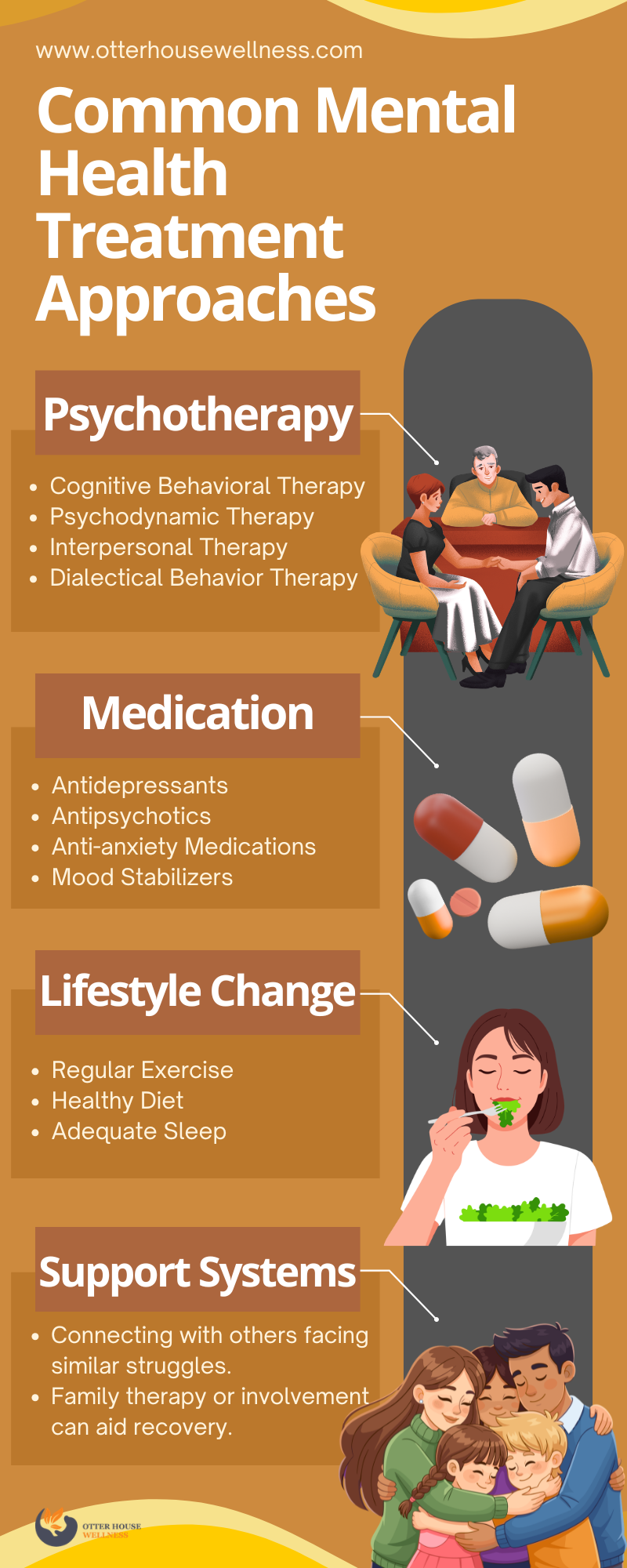
Standard outpatient therapy is the maintenance layer, where the more quiet, prolonged work is done once the higher-intensity care has laid the initial footing for it.
None of these levels is better or worse than another. They are just different answers to the same question: what does this person need, right now, to actually move?
The Diagnosis Under the Diagnosis
Most articles on mental health rehabilitation in North Carolina do not clearly state that individuals often come in thinking they have a single problem when they have two.
Substance use disorders tend to co-occur with mental health disorders, which are, however, treated much less. Some of the most likely conditions to co-occur with addiction are depression, anxiety, PTSD, and bipolar disorder.
However, only 7.4 percent of the millions of American adults with both conditions are treated at the same time. The remainder receive assistance on one side of the equation and silently ponder why it never works.
That is what dual diagnosis treatment in North Carolina is. The right program does not only inquire about what is going on but also what is motivating it. Such a question alters the whole of care that comes afterwards.
What North Carolina’s Mental Health Landscape Looks Like Right Now
North Carolina is in the 39th position out of all states in terms of access to mental health care. A fifth of adults in the state with symptoms of anxiety or depression indicate that they have an unmet counseling/therapy need.
The state is not standing still. A historic $835 million behavioral health investment has funded new crisis care centers. Medicaid reimbursement rates for providers have risen for the first time in over a decade, expanding urgent care access across the state.
What North Carolinians Should Seek In A Program
North Carolina programs must have state licensure at a minimum, and the most successful must have the extra certification of organizations such as the Joint Commission or CARF, which indicates a commitment to quality beyond the bare minimum. Accreditation is a benchmark, rather than a guarantee. The questions that matter most are harder to find on a website.
- Is the program doing a true clinical evaluation prior to placing you, or are they just fitting you into the available opening?
- Does the program include aftercare on the first day or provide you with a pamphlet at discharge?
- Do the therapists have evidence-based training, such as CBT, DBT, or trauma-informed treatment, or is the program developed on a vaguely defined philosophy with no clinical foundation?
- And, underneath all that, there is the less apparent question: does this place treat people like people?
A good program is one in which the therapeutic relationship is the primary focus. The facilities with the highest amenities are not the best in North Carolina. They are the ones in which somebody sat opposite you, asked the appropriate questions, and formed your care based on the responses.
Final Words
The map is only useful if you begin walking.
Otter House Wellness offers a full continuum of care in North Carolina, built around honest assessment and individualized treatment because the right level of care is the one that fits where you actually are, not where you think you should be. Reach out to our team today to find out what that level looks like for you.
Otter House Wellness
April 14, 2026
- Telehealth Therapy That Accepts Medicaid in North Carolina
 Tired of spending gas money and half a day driving to a therapist? Discover how NC Medicaid lets you see top providers from home with zero copay.
 - Group Therapy Covered by Medicaid in North Carolina
 Replaying the exact same thoughts at 2 AM with no way out? Discover how NC Medicaid fully covers the group therapy hack that breaks your mental loops.
 - Outpatient Mental Health Treatment for Medicaid Recipients in NC
 Did you know you don't need a doctor's referral to start therapy on NC Medicaid? Discover how to access fast, free mental health care from home.
 - Medicaid Mental Health Treatment for Parents and Families in NC
 You can't pour from an empty cup. Discover the "oxygen mask" rule in NC Medicaid that covers parent AND child mental health under one plan.
 - Mental Health Programs for Young Adults on Medicaid in North CarolinaDoes Rhode Island Medicaid cover treatment for addiction and depression? Find out what’s covered, from detox and residential care to PHP, IOP, therapy, and medication.
- ADHD Treatment That Accepts Medicaid in North Carolina
 Looking for ADHD treatment that accepts Medicaid in North Carolina? Learn about treatment options and how support can make daily life easier.
 - Bipolar Disorder Treatment Covered by Medicaid in NC
 Learn about bipolar disorder treatment covered by Medicaid in NC, including therapy, medication, Medicaid plans, and support options at Otter House Wellness.
Recommended Blogs


Telehealth Therapy That Accepts Medicaid in North Carolina

Group Therapy Covered by Medicaid in North Carolina